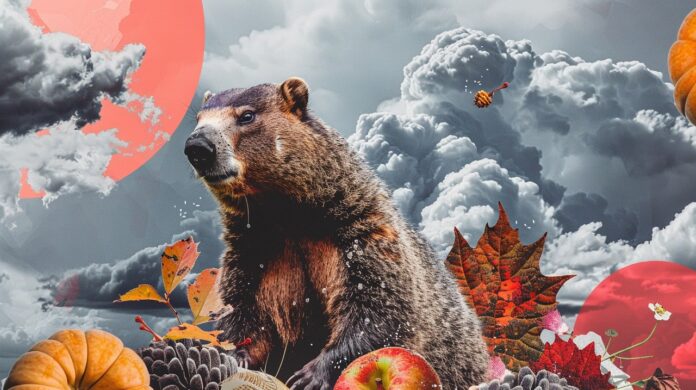
Let’s be honest: we live in an age where you can check the hourly precipitation of a random village in the Andes from your smartwatch while sitting on a toilet in suburban Ohio. We have satellites, supercomputers, and meteorologists with PhDs. And yet, every February, thousands of grown adults stand in a freezing Pennsylvania field waiting for a rodent named Phil to wake up and look at his own shadow.
It’s absurd, unscientific, and absolutely beautiful.
Groundhog Day isn’t just a quirky American holiday that inspired a Bill Murray movie; it’s the tip of a massive, global iceberg of “biological forecasting.” From the German forests to the rice paddies of China and the cattle ranches of Kenya, humans have spent millennia trying to hack the weather by watching animals, slicing open vegetables, and listening to the rhythm of the natural world.
So, why do we still do it? And what the hell does a persimmon seed have to say about your heating bill?
How a German Badger Became an American Icon?
If you think Punxsutawney Phil is the original weather prophet, you’ve been lied to. The whole “shadow-seeing” business actually started in Europe, specifically with the Christian holiday of Candlemas on February 2nd.
Back in the day, the vibe was simple: if Candlemas was sunny, winter was sticking around. If it was cloudy, spring was coming. But humans love a mascot, so the Germans decided to outsource the job to a badger (Dachs). The logic was that if the badger saw its shadow on Candlemas, it would get spooked and crawl back into its hole for another four weeks of hibernation.
When German immigrants (the Pennsylvania Dutch) moved to the U.S. in the 18th and 19th centuries, they realized Pennsylvania was severely lacking in badgers. But it was crawling with groundhogs. They made the swap, and by 1887, the first official Groundhog Day was celebrated at Gobbler’s Knob.
The “Inner Circle” and the Language of Groundhogese
Today, the tradition is run by the Inner Circle, a group of local dignitaries in top hats who claim to speak “Groundhogese.” They insist Phil is 100% accurate, despite NOAA’s data suggesting he’s right about 35% of the time. But accuracy isn’t the point—the point is the party.
The Bear Oracles of the Balkans

While Americans are obsessed with groundhogs, the folks in the Balkans and Eastern Europe have a much more intimidating forecaster: the Brown Bear.
In countries like Serbia, Hungary, and Romania, the tradition of Sretenje (Meeting of the Lord) on February 2nd mirrors the groundhog logic. If the bear emerges from its cave and sees its shadow, it gets scared and goes back to sleep for 40 more days.
In Hungary, this is a massive deal. Folklorists note that the bear’s behavior was once a life-or-death signal for farmers. If the bear stayed out, it meant the ground was warming up enough to start thinking about planting. If it retreated, you’d better keep your grain stores locked tight. You can read more about the Hungarian bear folklore here.
The “Awakening of Insects”: China’s Biological Alarm Clock
In the West, we look for one animal on one day. In China, the traditional calendar is a masterpiece of biological observation called the 24 Solar Terms.
One of the most fascinating is Jing Zhe, or the “Awakening of Insects”, which usually hits around March 5th. The belief is that the first spring thunder literally “wakes up” the hibernating bugs and animals.
It’s not just about insects, though. Ancient Chinese farmers watched everything:
- The Peach Blossoms: If they bloom early, expect a wet spring.
- The Orioles: Their first song is the official “start” of the working season.
- The Frogs: If they croak in a specific rhythm, it’s time to prep the rice paddies.
This isn’t just superstition; it’s a highly evolved system of phenology—the study of periodic plant and animal life cycle events. It’s so culturally significant that UNESCO added the 24 Solar Terms to its Intangible Cultural Heritage list.
Persimmons, Onions, and Pig Spleens: The Kitchen Forecasters
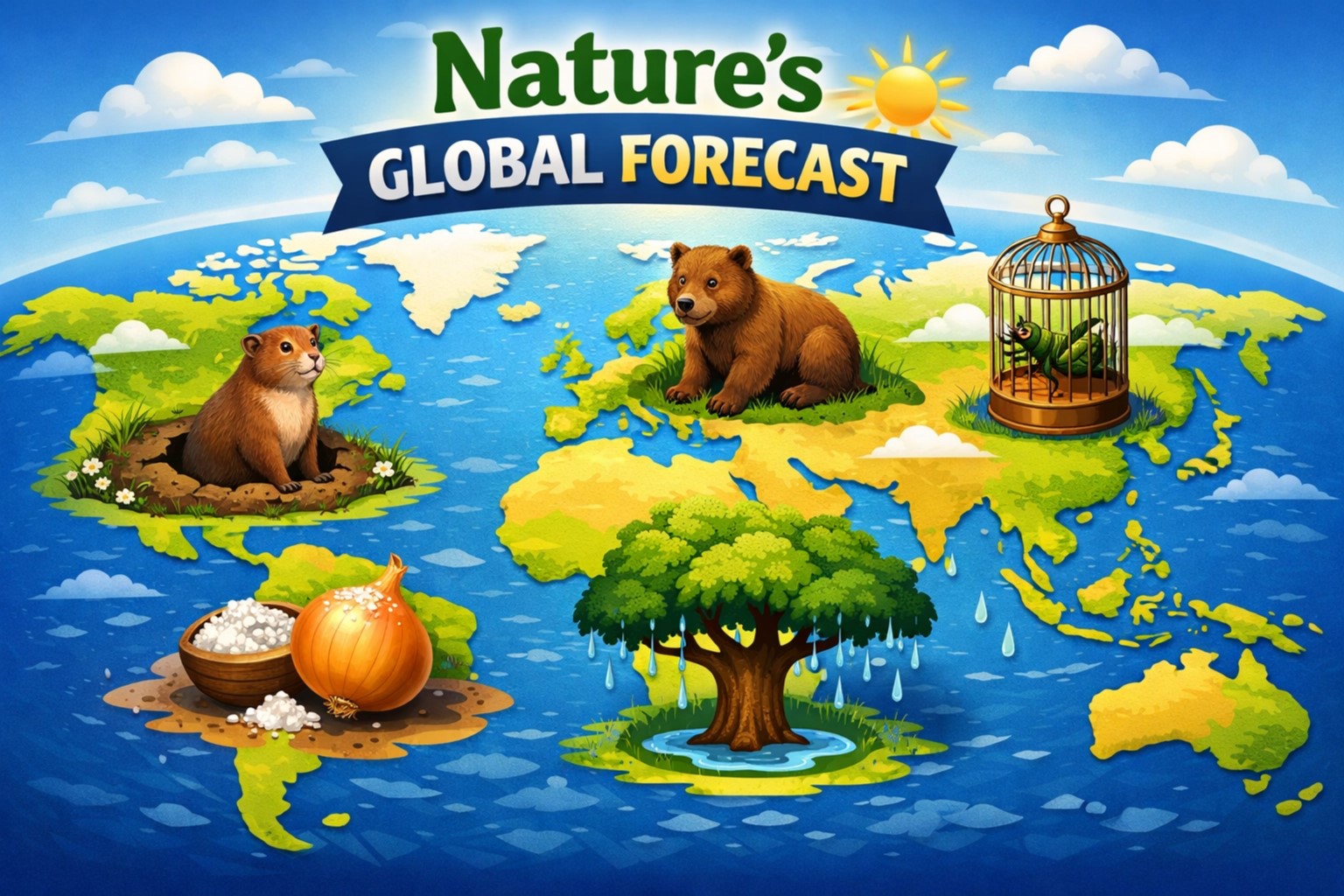
If you don’t have a groundhog or a bear handy, you can always check your pantry. Some of the most enduring (and weirdest) weather lore comes from the things we eat.
1. The Persimmon Seed “Cut”
In the American South and Midwest, people swear by the Persimmon Seed. You take a locally grown persimmon, crack open the seed, and look at the shape of the white embryo inside:
- A Spoon: Expect heavy snow (you’ll need a shovel).
- A Fork: A mild winter with light, powdery snow.
- A Knife: A “cutting” cold winter that will slice right through you.
The Farmers’ Almanac still tracks these every year, and people take it surprisingly seriously.
2. The Onion Calendar
This one is for the hardcore DIYers. An old German tradition involves taking 12 onion skins (one for each month), filling them with salt, and leaving them out overnight on Christmas Eve. In the morning, you check which skins are wet. The “wet” months will be the rainy ones. It’s called the Onion Calendar, and it’s still practiced in rural communities today.
3. The Pig Spleen (Yes, Really)
In parts of Canada and the U.S. Midwest, there’s a tradition of “reading” a pig spleen to predict the winter. If the spleen is thick at the beginning, the first half of winter will be cold. If it thins out, the end of winter will be mild. It’s definitely not for the squeamish, but it’s a testament to how farmers used every part of the animal—including its “meteorological” organs.
The “Rainmakers” of Kenya: Nature’s Data Scientists
In Western Kenya, the Nganyi community has been predicting the weather for centuries without a single satellite. They are known as “Rainmakers,” and their methods are a blend of ancestral knowledge and intense observation of the local ecosystem.
- The “Rain Tree”: A specific tree that drops its leaves just before the rainy season.
- Bird Migrations: The arrival of certain species from Europe or other parts of Africa.
- Ant Behavior: If ants start moving their eggs to higher ground, a flood is coming.
What’s cool is that modern scientists are actually collaborating with the Nganyi to improve local climate models. It turns out that centuries of observing a specific patch of land can be just as valuable as a computer model.
Why Folklore Actually Kind of Works?
Is a groundhog actually a meteorologist? No. But is there science behind this stuff? Yes.
Take Dolbear’s Law. In 1897, a physicist named Amos Dolbear realized you could calculate the temperature by counting the chirps of a cricket. The formula? Count the chirps in 15 seconds and add 40. That’s your temperature in Fahrenheit. NOAA confirms this works because crickets are cold-blooded; their metabolism (and thus their chirping) speeds up as it gets warmer.
Then there’s the Woolly Bear Caterpillar. Legend says the wider the orange band on its back, the milder the winter. While scientists say the band actually indicates the caterpillar’s age and how long the previous growing season was, it still provides a “biological record” of the local climate.
Why We Can’t Let Go
At the end of the day, Groundhog Day and its global cousins aren’t about beating the Weather Channel. They’re about connection.
In a world that feels increasingly digital and disconnected from the dirt beneath our feet, these traditions force us to stop and look at a tree, a bug, or a furry rodent. They remind us that we are part of an ecosystem that has its own rhythms, whether we’re paying attention or not.
So, next time you see a headline about Punxsutawney Phil or hear someone talking about the “spoon” in their persimmon seed, don’t roll your eyes. We’re just doing what humans have always done: trying to make sense of the clouds, one shadow at a time.
The “Wall of Fame”: Other Furry Forecasters You Should Know
Punxsutawney Phil might have the best PR team, but he’s far from the only game in town. Across North America, a whole league of “alternative” groundhogs (and other critters) are vying for the title of Top Prognosticator.
1. Staten Island Chuck (New York)
If you want accuracy, forget Phil. Staten Island Chuck (officially Charles G. Hogg) has an accuracy rate of around 80%, making him the undisputed king of the groundhog world. He’s also famous for biting former NYC Mayor Michael Bloomberg in 2009. New Yorkers take their weather—and their groundhogs—very seriously.
View this post on Instagram
2. Wiarton Willie (Canada)
Canada’s most famous forecaster is an albino groundhog named Wiarton Willie. Because he’s white, he’s much easier to spot in the Ontario snow. Willie has his own festival, and the town of Wiarton even has a statue dedicated to him.
3. General Beauregard Lee (Georgia)
Down South, they don’t wait for the snow to melt. General Beauregard Lee is a Southern gentleman of a groundhog who resides at Dauset Trails Nature Center. He’s been awarded honorary doctorates for his “weather wisdom” and has a remarkably high accuracy rate for the Southeast.
4. The “Woolly Worm” Festivals
In Banner Elk, North Carolina, they don’t even use mammals. Every October, they hold the Woolly Worm Festival, where caterpillars “race” up a string. The winner of the race is used to predict the 13 weeks of winter based on the colors of its body segments. It’s a massive event that draws over 20,000 people.
What Doesn’t Work
While we love a good story, some weather lore is just plain wrong. Here are a few myths you can safely ignore:
- “Clear Moon, Frost Soon”: Actually, this one is true. A clear sky at night allows heat to escape the Earth’s surface (radiational cooling), making frost much more likely.
- “Cows Lying Down Means Rain”: As we mentioned earlier, cows lie down for about 12 hours a day just to rest. If it rains while they’re down, it’s a coincidence.
- “Squirrels Gathering Extra Nuts”: Squirrels always gather as many nuts as they can find. Their “busyness” is more about how many nuts are available (a “mast year”) than how cold the winter will be.
Another fun fact: Did You Know Earth Has Minimoons?
How to Be Your Own “Biological Forecaster”
Want to try this at home? You don’t need a groundhog. Just keep an eye out for these subtle signs in your own backyard:
- Watch the Birds: If birds are flying high, the weather is usually clear. If they’re flying low or staying on the ground, the air pressure is dropping, which often means a storm is coming.
- Check the Pinecones: Pinecones are natural hygrometers. In dry weather, they open up to release their seeds. When it’s humid (pre-rain), they close up to protect them.
- Smell the Air: “Rain smells” is a real thing. It’s called petrichor, and it’s caused by the release of oils and bacteria from the soil when humidity rises. If the garden smells “earthy” all of a sudden, grab your umbrella.
View this post on Instagram
Final Thoughts
We live in a world of “certainty.” We want to know exactly when the rain will start and exactly when the snow will stop. But there’s something deeply human about the uncertainty of Groundhog Day. It’s a reminder that nature doesn’t always follow our schedules.
Read Next: Surprising Traditions That Show How Hawaii Keeps Its Identity