A cheap acre is only cheap until you try to build on it. People find a listing, fall for the view, and sign before anyone has asked whether a house can legally go there. Then the bills arrive. A road that has to be cut in. A septic system the soil will not accept. A power line that stops half a mile short. The homework is boring, but it decides whether your build stays on budget or quietly doubles.
Key Takeaways
- Confirm zoning, setbacks, and the real buildable area before you agree on a price.
- Recorded legal access matters far more than a driveway you can see from the road.
- A failed perc test can make a parcel unbuildable, so test before you close.
- Utility connections are usually the largest hidden cost in raw land.
- A title search and a fresh survey catch easements and boundary problems early.
- Land loans work differently from mortgages, so sort out financing before buying land.
What the Land Is Allowed to Become
Every parcel comes with a rulebook attached, and that rulebook is written by the county, not the seller. Buying land without reading it is how people end up owning a gorgeous lot they cannot build on. Start at the planning or zoning office and ask your questions in writing.
Zoning, Setbacks, and Buildable Area
View this post on Instagram
Zoning tells you what use is permitted. Setbacks tell you how far a structure must sit from every property line, road, stream, and easement. Subtract all of that and what remains is the buildable area, which is often much smaller than the acreage suggests. Slopes, rock, and drainage swales shrink it further.
Sketching a house, driveway, well, and septic field inside that envelope early is worth the effort, and site plans from Get a Site Plan give you a scaled version for the county.
Ask about lot coverage limits, height limits, and whether deed restrictions or HOA covenants stack on top of county rules.
Access Has to Be Legal, Not Just Visible
A dirt track running to the parcel proves nothing. What you need is recorded legal access, either frontage on a public road or a written easement across someone else’s land. Landlocked parcels sell cheap for a reason.
If access runs over a private road, find out who maintains it and what your share costs. Easements can also stay quiet for years before anyone enforces them.
Broker Diane Wilson told This Old House about a client whose parcel carried a highway easement nobody knew about until she went to sell.
The Ground Under Your Future House
Two lots on the same street behave completely differently once you dig, which is why buying land without soil information is a gamble. Soil type, water table, and drainage decide what foundation and wastewater system the site will take.
Soil and Perc Tests
If there is no municipal sewer, the parcel has to support a septic system, and that means a percolation test. Soil that drains too slowly leaves you with a saturated drain field. Soil that drains too fast sends effluent toward groundwater untreated. Either result can push you into a pricier alternative system or rule out a house entirely.
Run the parcel through the USDA Web Soil Survey first. It is free and flags shallow bedrock and seasonal wetness before you pay anyone. It is not a substitute for a field test, so make your offer contingent on passing one.
Flood Zones and Wetlands
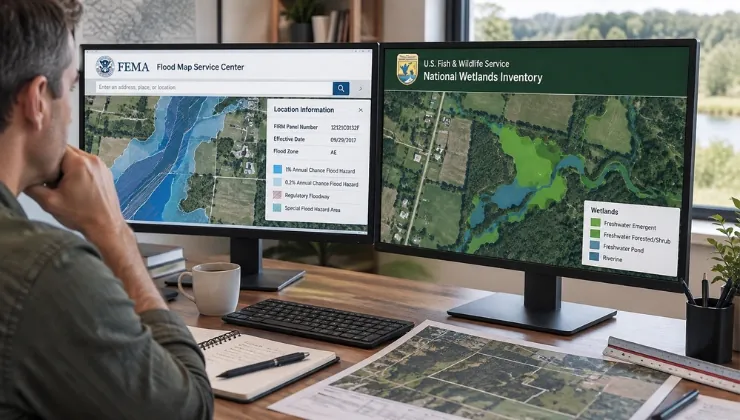
Pull the address on the FEMA Flood Map Service Center and note the zone, panel number, and effective date. Any area with a one percent or greater annual chance of flooding counts as high risk, and lenders use those maps to decide whether flood insurance is required.
Then check the USFWS Wetlands Mapper. Wetland indicators do not automatically block a build, but they change the permitting path.
Utilities Turn Cheap Land Into Expensive Land
Raw land is priced as raw land because someone still has to bring services to it. Trenching, poles, meters, and tap fees get quoted per foot, and the numbers turn ugly on a long driveway.
| Service | What to confirm | Who to ask |
| Electricity | Distance to the nearest line and cost per foot to extend it | Local utility engineering desk |
| Water | Municipal tap availability, or typical well depth nearby | Water district or county health |
| Wastewater | Sewer connection point, or approved septic system type | County health department |
| Road and driveway | Culverts, grade limits, and county acceptance standards | Public works department |
When the Grid Is Too Far Away
If the quote to run power comes back absurd, off grid becomes a real option rather than a lifestyle choice. Panels and batteries have gotten cheap enough that a well specced solar setup can beat a long line extension.
Title, Survey, and Boundaries
Nobody enjoys reading a title commitment, but Schedule B is where the surprises live. Easements, rights of way, liens, mineral reservations, and old restrictions sit there in plain language.
Why a Fresh Survey Pays for Itself
Lenders commonly require an ALTA survey before issuing a mortgage on vacant land, and title companies sometimes want one before they will insure it. Skip it and the title company probably will not cover the exact problems a survey would have caught. An old survey in the seller’s file is a starting point, not proof of anything.
Budget for the Whole Path, Not Just the Purchase
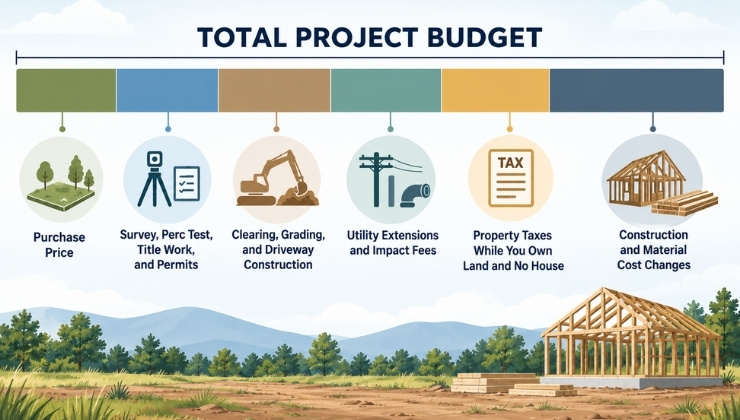
The purchase price is one line in a much longer spreadsheet. Before you commit, price out the rest:
- Survey, perc test, title work, and permit fees
- Clearing, grading, and driveway construction
- Utility extensions and impact fees
- Property taxes while you own land and no house
Then look at the build. Material prices and tariffs can shift your number between the offer and the first pour, and it helps to know which materials are running short before you lock a schedule with a builder.
Frequently Asked Questions
Final Thoughts
Buying land rewards patience in a way almost nothing else in real estate does. The checks that feel like a wasted Saturday, the call to the zoning office, the free soil report, the survey you did not want to pay for, are the same ones that keep a project from stalling. Walk the parcel twice, once after rain. Ask the neighbors what floods. Put every contingency in writing.