
More workers are building careers around several roles instead of relying on one traditional job.
Full-time employment may still provide a steady paycheck, but freelance projects, consulting, creative work, and small businesses often add extra income and new professional options.
A record 8.9 million U.S. workers held multiple jobs, marking the highest level reported since 2009.
Such growth points to a broader shift in how people think about employment, security, and career progress.
Portfolio careers give workers greater control over how they earn, learn, and plan for uncertainty.
Several income sources can also reduce the financial damage caused by a layoff, a lost client, or an unexpected change at work.
Why the 9-to-5 Is Losing Its Pull
Stagnant wages and higher living costs have made one paycheck less reliable for many households.
Recent household data support that pressure. In 2024, 37% of U.S. adults said their family’s monthly spending had increased compared with a year earlier, while only 32% reported higher monthly income.
Spending growth exceeded income growth for a third consecutive year, helping explain why additional earnings have become more important for many workers.
Inflation has raised spending on housing, food, transportation, insurance, and other essentials, while salary growth has not always kept pace.
Layoff concerns add another source of pressure. Depending on one employer means a single company decision can eliminate all earned income at once.
Extra work can act as a backup plan, even when it initially produces only a modest amount.
Professional growth also matters. Nearly half of employees say opportunities to learn new skills affect their decision to stay in a job or leave it.
Traditional roles do not always provide enough training, advancement, or room to try new types of work.
Several changes have made outside income easier to pursue:
- Freelancers can contact clients through online marketplaces and professional networks.
- Creators can publish newsletters, videos, podcasts, and educational materials directly to an audience.
- Specialists can sell consultations, workshops, templates, or courses without opening a physical office.
- Payment, scheduling, marketing, and project-management tools can support small operations at a relatively low cost.
Companies also use independent professionals to gain access to specific skills without making long-term hiring commitments.
How People Stack Income Streams
Many portfolio careers begin with an anchor job.
A full-time position covers core expenses, while additional work creates extra cash, builds skills, or tests a future business idea.
Among others, we can see that travel advising can also become a flexible income stream for people interested in planning trips and working with clients.
Yeti Travel offers self-paced training, supplier access, business tools, and support for advisors who want to work part-time, full-time, or somewhere in between.
Katelyn Cusick, age 29, combines several distinct roles:
- A full-time visual-merchandising position provides her primary income.
- Influencer-management work takes 10 to 15 hours each week.
- An Etsy shop gives her a place to sell original paintings.
- Concert ushering adds another source of paid work.
Her schedule shows how income stacking can involve several types of work at once.
One role provides stability, another keeps marketing skills current, and creative work offers a possible path to greater independence.
Professionals can also turn one area of expertise into several offers. A designer might provide client services, sell templates, teach workshops, create a course, and publish a paid newsletter.
A finance specialist might combine consulting, coaching, speaking, and digital resources.
One software architect built a newsletter audience of 500 subscribers in three months.
More than 40 copies of a $67 digital guide were sold, followed by consulting and digital-product income exceeding $3,000 per month.
Results came through an individual promotional case study, so they should not be treated as a typical outcome.
Connected income sources are often easier to manage than unrelated gigs. Skills, contacts, material, and reputation gained in one activity can support the others.
A practical sequence may look like this:
- A newsletter attracts potential consulting clients.
- Client questions reveal topics for workshops or courses.
- Course buyers later purchase templates, coaching, or advanced resources.
- Completed projects produce case studies that help secure new work.
Benefits of a Portfolio Career
Several income sources can create a financial cushion. Losing one client or project may still hurt, but it does not always erase all monthly earnings.
Additional work can also keep professional skills active. Working across several roles may speed up learning.
Experience gained outside a primary job can later support a promotion, career change, or independent business.
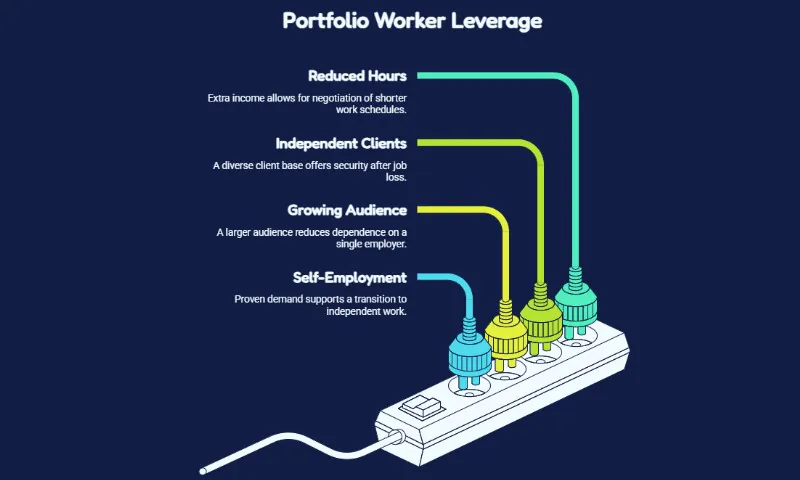
Portfolio workers may gain several forms of leverage:
- Extra income can make it easier to request reduced hours.
- Independent clients can provide options after a layoff.
- A growing audience can reduce reliance on one company for future opportunities.
- Proven demand can support a gradual move into self-employment.
Personal interests can become part of professional life as well.
Someone may combine technical expertise with teaching, environmental work, community projects, art, or another cause that matters to them.
More options can create a stronger sense of control. Career security no longer depends entirely on one title, manager, or company.
How to Start

Begin with one skill that already has practical value.
Work experience, hobbies, volunteer projects, and previous assignments may reveal services people are willing to pay for.
Clear financial planning should come next. Before launching anything, calculate several key figures:
- Essential monthly expenses
- Emergency savings needs
- Estimated self-employment taxes
- Startup and operating costs
- Realistic monthly income for each activity
- Hours available without harming health or primary job performance
Small tests can reduce risk. Offer a limited service, create a pilot product, run a short workshop, or complete a trial project before spending heavily.
Starting small matters because turning an additional income source into a lasting business can take time.
Among new U.S. employer establishments launched between 1994 and 2022, 67.7% survived for at least two years, while 49.2% reached the five-year mark.
Early testing can help workers measure demand and correct weak ideas before committing substantial money or leaving stable employment.
Samples, testimonials, case studies, client results, and published work can show potential buyers what they can expect.
Stable employment can provide breathing room during the early stage.
Ideas can be tested without requiring immediate salary replacement.
A gradual transition may include several practical moves:
- Negotiating a four-day workweek
- Moving into part-time employment
- Saving several months of living expenses
- Securing recurring clients before resigning
- Turning a former employer into a consulting client
Careful limits are also important. Two or three sustainable income sources are often more useful than a long list of exhausting commitments.
FAQs
Summary
Portfolio careers are changing how workers define security and success.
Traditional employment still plays an important role, but one salary may no longer provide enough income, stability, or professional growth for every worker.
Additional income sources can create options during layoffs, career changes, and periods of rising costs.
Side work may also help people learn new skills, meet new contacts, and test business ideas without giving up a steady paycheck.
Constant work should not be the goal. A well-planned portfolio career should create greater control, useful skills, and less dependence on decisions made by a single employer.